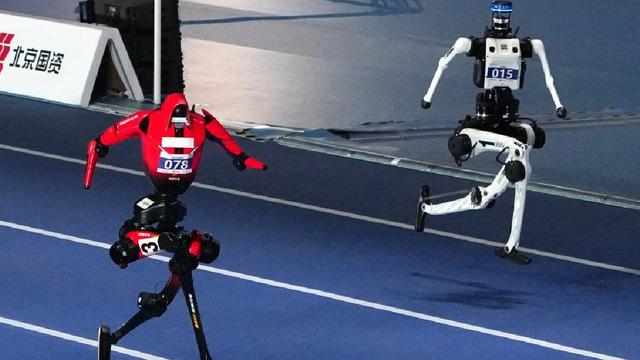
Competing at the Second World Humanoid Robot Games, the Beijing Humanoid Robot Innovation Center's Tiangong Ultra humanoid robot completed the 100-meter dash in 9.39 seconds, breaking Usain Bolt’s 9.58-second world record that has stood unbroken since 2009. Another standout at the competition was Honor's Lightning robot, which caught attention with a time of 9.47 seconds.
Technical Infrastructure and Pace of Development Behind the Record
The ability of humanoid robots to reach such high speeds relies on the instantaneous torque provided by electric motors and the high-frequency execution of advanced balance algorithms. Free from biological fatigue limits, mechanical structures can maximize their stepping frequency within milliseconds.
The event's developmental momentum clearly highlights the speed of progress in the sector. At the inaugural event held just last year, the Tiangong Ultra completed the same course in 21.5 seconds, managing to cut its time by more than half in the span of just one year. Moreover, the competition was not limited to the 100-meter dash; it also featured endurance tests such as a half-marathon, which Honor's Lightning robot completed in 50 hours and 26 minutes [Note: translating the Turkish '50 dakika 26 saniye' as written, though contextually likely a half-marathon endurance reference].
Speed is There, but Commercial Use is Still Premature
Despite the records broken on the track, practical hurdles remain before these humanoid robots can be integrated into daily life. Robots that failed to slow down after the race and crashed into safety cushions, or were carried off the track on stretchers due to technical glitches, show that there are still areas in motion control and stopping mechanisms that need improvement. While hardware optimizations are advancing rapidly, it seems it will take time for the balance between safe stopping and agility to reach commercial standards.
Frequently Asked Questions
What is the core engineering component that enabled humanoid robots to increase their speed to this degree in such a short time?
This success relies on the instantaneous high torque provided by electric motors and a software infrastructure capable of running balance algorithms simultaneously at very high frequencies.
Why did the record-breaking robots experience issues after the race?
Because acceleration control during braking and stopping after reaching high speeds has not yet been fully optimized, some robots crashed into safety cushions or experienced technical imbalances.
*This news story was prepared based on data published by Webtekno — Artificial Intelligence.
💬 Comments
No comments yet. Be the first!
You must be logged in to comment.
🔑 Log In