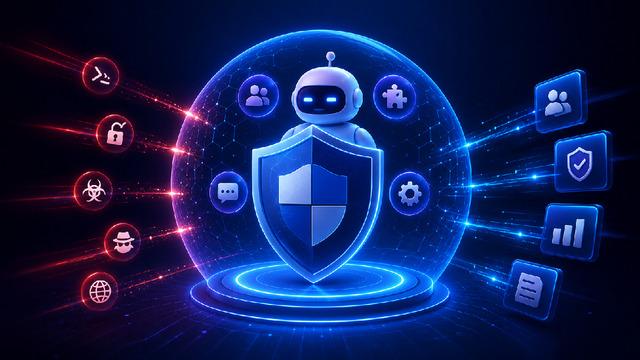
At an event in San Francisco, Microsoft announced MAI-Cyber-1-Flash, its first cybersecurity-focused AI model, alongside Perception, a new platform designed to automate security processes. Positioning itself against industry giants like Anthropic, Google, and OpenAI, these new tools were developed to detect vulnerabilities in complex codebases and accelerate manual security reviews.
What Do MAI-Cyber-1-Flash and the MDASH Toolkit Offer?
The newly introduced MAI-Cyber-1-Flash model was specifically designed to uncover challenging vulnerabilities hidden within complex codebases. The model works seamlessly with MDASH, a tool developed for software vulnerability detection and remediation. Mustafa Suleyman, CEO of Microsoft AI, stated that the architecture within MDASH outperformed competitor solutions during Cyber Gym tests.
AI Agents Take Action with the Perception Platform
The newly unveiled Perception cybersecurity platform deploys multi-layered teams of AI agents to optimize security workflows. The system is organized into distinct teams: "red" teams that generate attack simulations, "blue" teams that detect flaws, and "green" teams that execute corrective actions. According to Microsoft engineers, this architecture reduces manual security reviews—which typically take hours—down to mere minutes.
Industry Implications and the Competitive Landscape
As tech companies accelerate their investments in AI for cybersecurity, Microsoft's move is shifting market dynamics. Handling codebase vulnerability detection and autonomous remediation through AI agents has the potential to directly impact the cost and duration of enterprise cybersecurity operations in the near future.
Frequently Asked Questions
What exact roles do the red, blue, and green AI agents play in the Perception platform?
The red teams generate potential cyberattack simulations, the blue teams detect existing flaws in the system, and the green teams automatically execute corrective actions to address the identified flaws.
How does the MAI-Cyber-1-Flash model differ from traditional security scanning tools?
The model is specifically trained to find elusive vulnerabilities in complex codebases and works in tandem with the MDASH tool—which integrates software vulnerability detection and remediation—outperforming competitors in testing.
*This news report is based on data published by Webtekno — Artificial Intelligence.
💬 Comments
No comments yet. Be the first!
You must be logged in to comment.
🔑 Log In