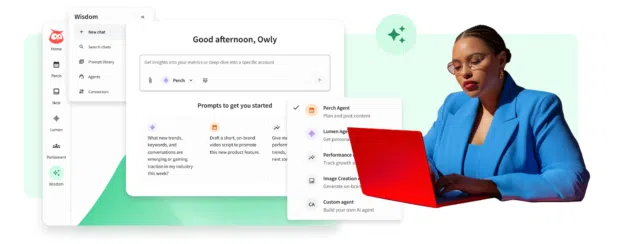
Social media AI agents are advanced artificial intelligence software programs that make autonomous decisions and execute actions to achieve specific goals, rather than constantly waiting for user prompts. Unlike standard chatbots, they can run repetitive background tasks—such as micro-influencer research, competitor analysis, and weekly reporting—without requiring human intervention.
What Are the Key Differences Between Chatbots and AI Agents?
Basic chatbots commonly used on the market, such as ChatGPT or Claude, are entirely reactive; they only respond to the questions you ask and do not step outside the commanded steps. In contrast, social media AI agents are proactive.
When an AI is given a goal, context, and access to appropriate tools (such as Google Sheets or brand guidelines), it decides what the next steps should be on its own. For example, if you ask it to find micro-influencers in your niche, it researches content creators, selects the most suitable ones, compiles a short list, and can repeat the process entirely independently months later while adhering to its schedule.
Use Cases and Limitations of AI Agents in Digital Marketing
Social media professionals have started integrating these agents into almost every workflow, including strategy development, content creation ideas, community management, and data reporting. However, for this autonomous structure to operate safely, it is essential to define specific guardrails.
Marketers must clearly determine which tasks should be executed entirely autonomously and which ones require human approval. These agents offer massive operational efficiency, particularly in continuous and repetitive tasks such as weekly reporting, competitor tracking, and sentiment analysis (sentiment shifting).
Industry Implications and Key Considerations
The integration of AI agents into digital marketing processes significantly reduces teams' routine and operational workloads while bringing the role of strategic oversight to the forefront. For marketing professionals, correctly outlining the limits of these tools remains a critical balancing factor in terms of data security and brand voice consistency.
Frequently Asked Questions
Which tasks can social media AI agents perform entirely without human intervention?
AI agents can autonomously perform repetitive, rule-based processes such as micro-influencer research, periodic competitor monitoring, reporting on sentiment analysis shifts, and weekly data collection.
What should a business define first when starting to use AI agents in its social media processes?
As a first step, businesses must clearly define which operations the agents can perform alone, which steps must go through human approval, and the brand's operational guardrails.
*This news article was prepared based on data published by the Hootsuite Blog.
💬 Comments
No comments yet. Be the first!
You must be logged in to comment.
🔑 Log In