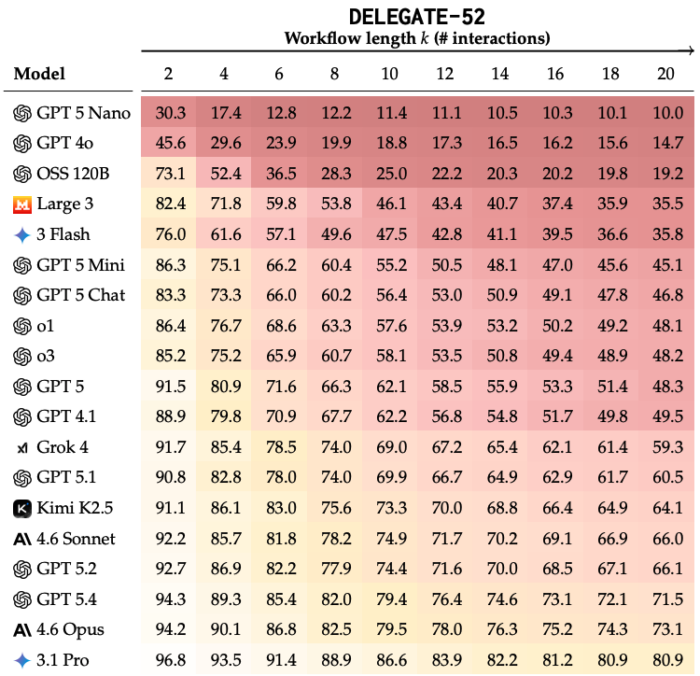
According to a study titled DELEGATE-52 published by Microsoft Research, popular large language models (LLMs) silently corrupt an average of 25% of content in long-form document editing processes, and up to 50% across all models combined. The fact that these errors appear grammatically correct while containing critical logical or structural losses has reignited debate over the reliability of AI in content creation and editing workflows.
Striking Findings from the DELEGATE-52 Study
The research tested 19 different large language models across 52 professional fields, ranging from coding and accounting to fiction and musical notation. In tests where models were subjected to 20 consecutive editing interactions, the key findings were:
- Hidden and Severe Errors: The distortions made by AI are not random typos, but rather structural changes that are difficult to spot at first glance yet lead to critical shifts in meaning.
- Model Performance: Even the most advanced frontier models corrupted a quarter (25%) of the documents by the 20th interaction. The average across all models pointed to a corruption rate of 50%.
- Domain Success: Python coding was the only field where most models managed to exceed the 98% accuracy threshold defined in the study. Even the best-performing model achieved this threshold in only 11 different fields.
- Impact of Agentic Tools: Equipping AIs with basic agentic infrastructure featuring file tools did not improve performance; on the contrary, it increased the corruption rate by approximately 6% while consuming 2 to 5 times more tokens.
Industry Implications for Digital Marketing and Content Creation
This research serves as a strategic warning regarding the role of AI in content production processes. Rather than handing texts entirely over to AI, agencies, SEO specialists, and content marketers must increase human oversight in multi-stage revisions. During long-term document updates, regular checks should be performed to ensure the model has not compromised the prior context at each step.
Frequently Asked Questions
Why can't traditional spell-check tools catch AI editing errors?
Because the errors are not misspelled words or typos, but rather logical shifts that look grammatically flawless while undermining structural integrity or technical accuracy.
Does the same risk rate apply to one-off, short text edits?
The research specifically focuses on multi-session, long-term editing workflows; cumulative errors tend to multiply exponentially as the number of interactions increases (multi-turn workflows).
*This news report was prepared based on data published by the Neil Patel Blog.
💬 Comments
No comments yet. Be the first!
You must be logged in to comment.
🔑 Log In