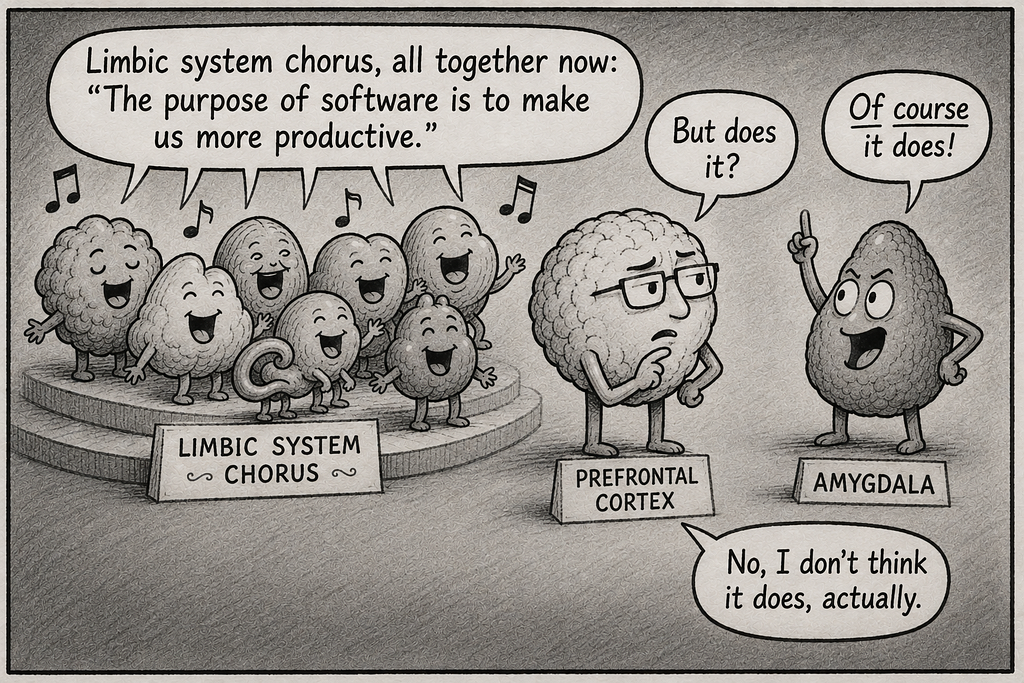
The belief that the fundamental purpose of software is to increase efficiency and productivity has long been a widely accepted misconception in the tech world. With the rise of AI-powered tools and large language models (LLMs), the boom in software production is bringing this fundamental question back to the agenda: What exactly do these intense digital outputs serve, and what is the true raison d'être of software?
Increased Output Does Not Mean Productivity
Since 1971, global computing power has increased by a trillion-fold (10¹²), yet economic and sectoral productivity growth rates have fallen to less than half of their mid-20th-century levels. This paradox proves that high production speeds achieved through software do not automatically translate into an increase in economic or functional productivity. The multiplication of output volume does not mean that real problems solved or value added have increased at the same rate.
Information Density and the Core Function of Software
Analyses conducted in technology and IT development processes reveal that the true role of software in the social and digital ecosystem is to increase information density per unit of digital output. While the speed-multiplier effect provided by AI facilitates code or content generation, it also brings along the necessity to make sense of and manage these massive data heaps.
Sectoral Reflections and Future Outlook
In this era where AI tools dominate software development processes, the quantity-driven production boom is prompting industry professionals to make a strategic assessment. Faced with the volume generated by these tools, placing human cognition and critical thought at the center constitutes a critical threshold for preserving the quality of digital products.
Frequently Asked Questions
Why doesn't AI directly reflect on economic productivity while increasing software production speed?
Although the exponential increase in computing power raises the volume of production (quantity) provided by automation, it does not grow added value or economic output (quality) in business processes at the same rate; this is because the real bottleneck is no longer writing code, but solving the right problem.
If the primary function of software is not productivity, where should digital designers and developers shift their focus?
Rather than increasing the sheer volume of output, developers and designers should focus on optimizing the information density of the digital outputs produced and keeping their own critical decision-making mechanisms active.
*This news article was prepared based on data published by the UX Collective.
💬 Comments
No comments yet. Be the first!
You must be logged in to comment.
🔑 Log In