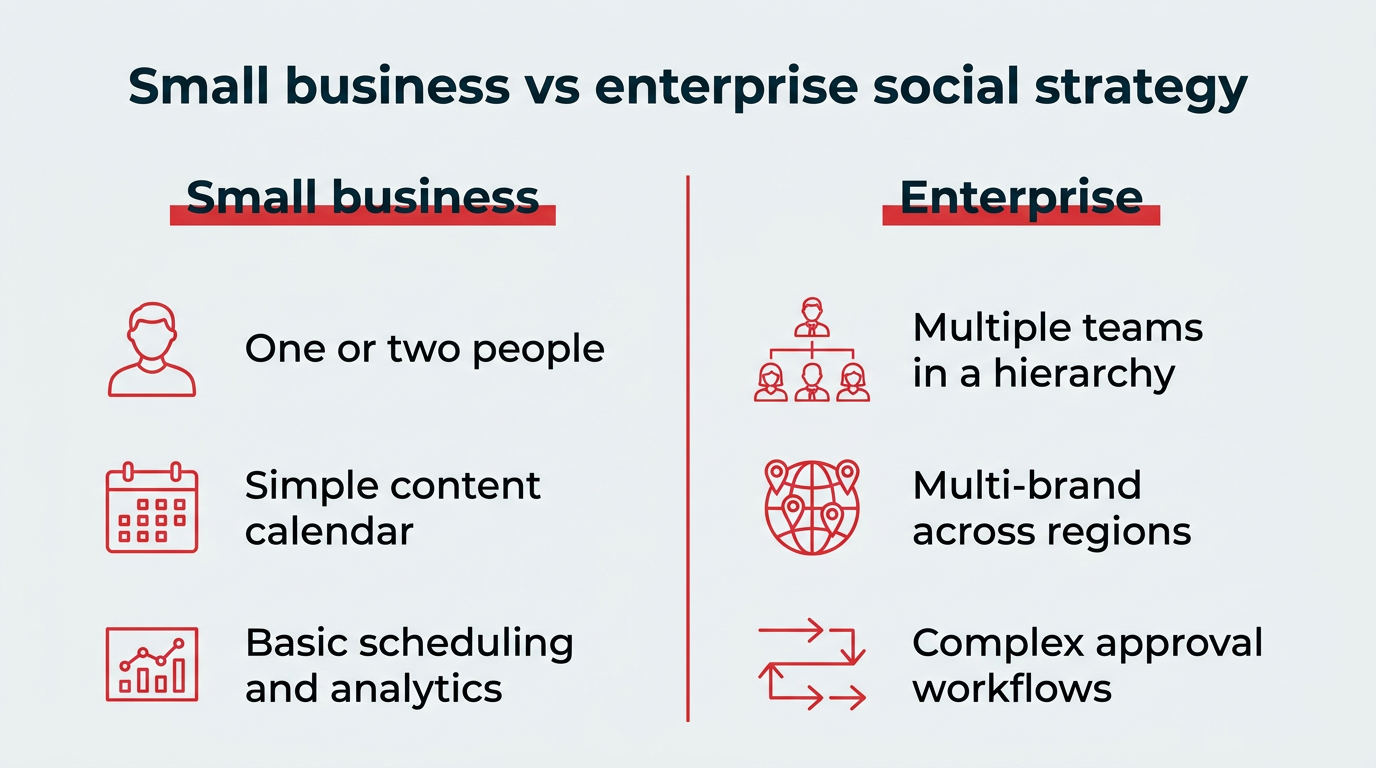
An enterprise social media strategy is a comprehensive plan that enables large organizations to coordinate content publishing, management, measurement, and AI tools across multiple teams, brands, and regions under a single roof. According to recent data published by the Hootsuite Blog, scaling external brand communication and market intelligence has become a fundamental necessity for modern businesses.
Core Components of Enterprise Social Media and Scaling Challenges
Social media management in large-scale organizations differs significantly from operations run by small teams. In structures involving hundreds of employees and multiple brands, the biggest obstacles encountered are:
- Inconsistent Brand Voice: Different departments or agencies failing to capture a unified tone.
- Slow Approval Processes: Inability to respond quickly to crises or trending topics due to hierarchical bottlenecks.
- Fragmented Tools: Using separate software for different channels and failing to consolidate data.
- Difficulty Proving Return on Investment (ROI): Being unable to present social media’s financial contributions to the board of directors with clear figures.
To overcome these issues, organizations increasingly favor platforms that combine listening, publishing, customer care, employee advocacy, and analytics into a single system.
Differences Between Enterprise Social Media and Enterprise Social Networks
Many professionals confuse outward-facing social media management with internal corporate communication networks. To build an accurate strategy, these two concepts must be distinguished:
- Enterprise Social Media: Covers outward-facing platforms such as LinkedIn, Instagram, and TikTok. Its primary purpose is brand marketing, customer engagement, and external communication. Success metrics are measured through engagement, reach, and sentiment analysis.
- Enterprise Social Network: Consists of internal tools such as Yammer, Viva Engage, and Slack. Its primary purpose is employee collaboration and internal knowledge sharing. Success metrics are based on adoption rates and participation levels.
Sectoral Implications and the Role of AI
By 2026, AI-driven insights and governed workflows have shifted from being optional features to standard requirements in enterprise social media management. Global enterprises and large domestic companies operating across multiple markets are expected to turn to AI-integrated unified platforms to optimize human resources and operational costs. This centralized approach, which reduces tool fatigue, also enhances the transparency of ROI reports presented to boards of directors.
Frequently Asked Questions
What steps should companies take to eliminate tool fragmentation in their social media strategies?
Companies can prevent operational clutter by migrating to enterprise platforms that offer listening, publishing, customer care, analytics, and employee advocacy modules within a single interface.
How is AI integrated into social media management processes in large-scale enterprises?
AI is utilized as a central workflow layer to automate data analytics, extract audience insights, generate content recommendations, and streamline large-scale approval processes.
*This article was prepared based on data published by the Hootsuite Blog.
💬 Comments
No comments yet. Be the first!
You must be logged in to comment.
🔑 Log In