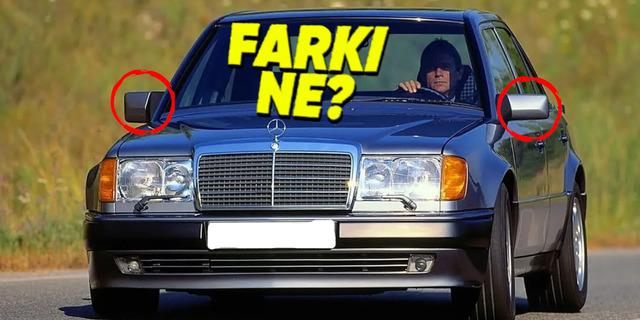
The fact that the right wing mirror on Mercedes-Benz’s legendary W124 model was designed smaller than the left was not a mistake or a manufacturing defect; rather, it was a deliberate engineering choice aimed entirely at optimizing the driver’s field of vision. With the driver seated on the left, functionality was prioritized over visual symmetry to ensure the best possible view of the right blind spot and to facilitate parking maneuvers on the narrow European streets of the 1980s.
Symmetry Sacrificed for Functionality
Because left-hand drive places the driver on the left side of the vehicle, producing two mirrors of identical physical dimensions was technically impractical. While the left mirror was designed in a taller and narrower form, the right mirror was developed with a higher, more square geometry. As a result, the right mirror provided the driver with the necessary wide field of vision without protruding unnecessarily from the vehicle's body.
This asymmetrical design approach did not debut with the W124; a similar philosophy was adopted for the W201 (190) model introduced in 1982. By optimizing the car’s overall width on the narrow streets of that era, this detail prioritized practical usability over aesthetic concerns.
Why Modern Cars No Longer Use This Design
The primary reason such asymmetrical mirror designs are no longer seen in today’s automotive industry is the advancement of driver assistance systems. Technologies such as power mirror adjustments, convex wide-angle glass, blind-spot monitoring systems, and mirrors that tilt down automatically in reverse have eliminated the need to expand the field of vision through physical size discrepancies. One of the elements that makes the W124 iconic is the fact that it produced purely mechanical and geometric solutions using the limited technological means of its time.
Frequently Asked Questions
Did this asymmetrical mirror design negatively affect the vehicle's aerodynamics or fuel consumption?
No, on the contrary, the more compact dimensions of the right mirror contributed to reducing wind resistance (drag) and keeping cabin wind noise to a minimum.
How does the difference in size between the right and left mirrors affect the process of finding spare parts or replacement costs?
Because the parts are not symmetrical, the right and left mirror housings and glass are not interchangeable. However, since W124 parts are still widely manufactured in the classic car market, this does not pose a major disadvantage during sourcing.
*This news article was prepared by Webtekno based on data published by Artificial Intelligence.
💬 Comments
No comments yet. Be the first!
You must be logged in to comment.
🔑 Log In