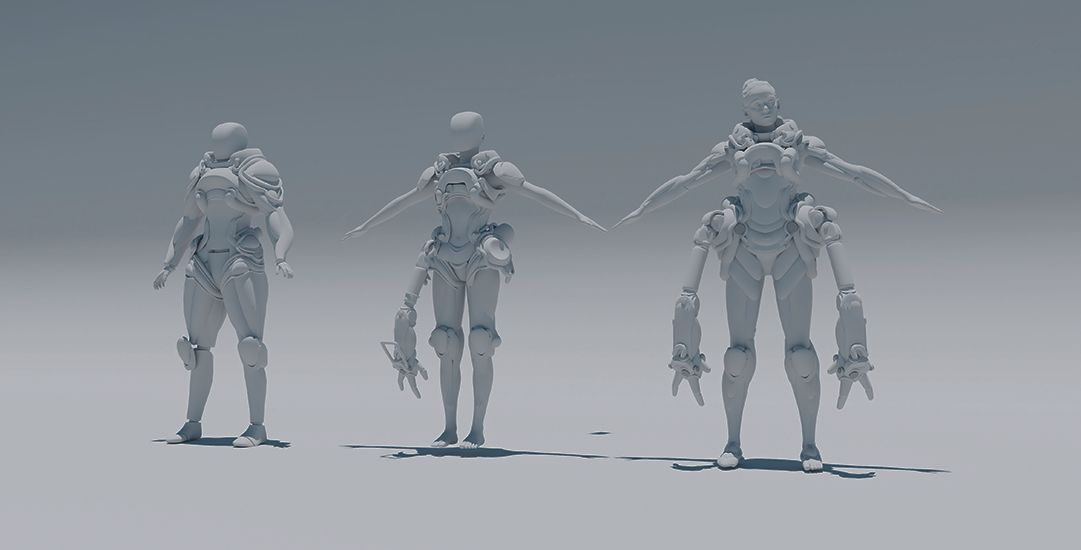
Digital artist Bart Tchorzewski has shared a new production workflow that combines virtual reality (VR) tools with the traditional 3D modeling software Blender to design a futuristic robot figure. This hybrid approach enables designers to achieve more organic forms during the conceptual stage and significantly accelerates the process.
Stages of the Hybrid Design Process
The artist's workflow offers key insights into how modern technologies and classical methods can be blended. The process basically consists of the following steps:
- Rapid Prototyping with VR: The virtual reality environment allows designers to draw and shape directly in three-dimensional space. As a result, the basic outlines and volume of the futuristic robot are created in a much more intuitive way.
- Detailing with Blender: The basic skeleton built in the VR environment is transferred to Blender for detailed modeling, texturing, and scene layout. Blender's powerful polygon editing tools enable the addition of industrial and mechanical details to the robot figure.
Industry Implications
The integration of traditional 3D modeling software with virtual reality technologies substantially shortens production times, particularly for concept artists and game developers. Being able to design directly in 3D space, free from screen constraints, reduces barriers in the creative process and supports the creation of futuristic and complex assets in a much shorter timeframe.
Frequently Asked Questions
How does incorporating VR tools into the concept design process affect the learning curve?
Although VR tools initially require adapting to spatial perception, because they facilitate intuitive shaping, they allow you to make anatomical and volumetric decisions much faster compared to traditional methods.
What hardware and software infrastructure is required for this hybrid workflow?
A basic VR headset, appropriate controllers, VR-supported modeling software (such as Gravity Sketch), and an up-to-date 3D graphics program like Blender to finalize the assets are sufficient for this process.
*This news article was prepared based on data published by Creative Bloq.
💬 Comments
No comments yet. Be the first!
You must be logged in to comment.
🔑 Log In