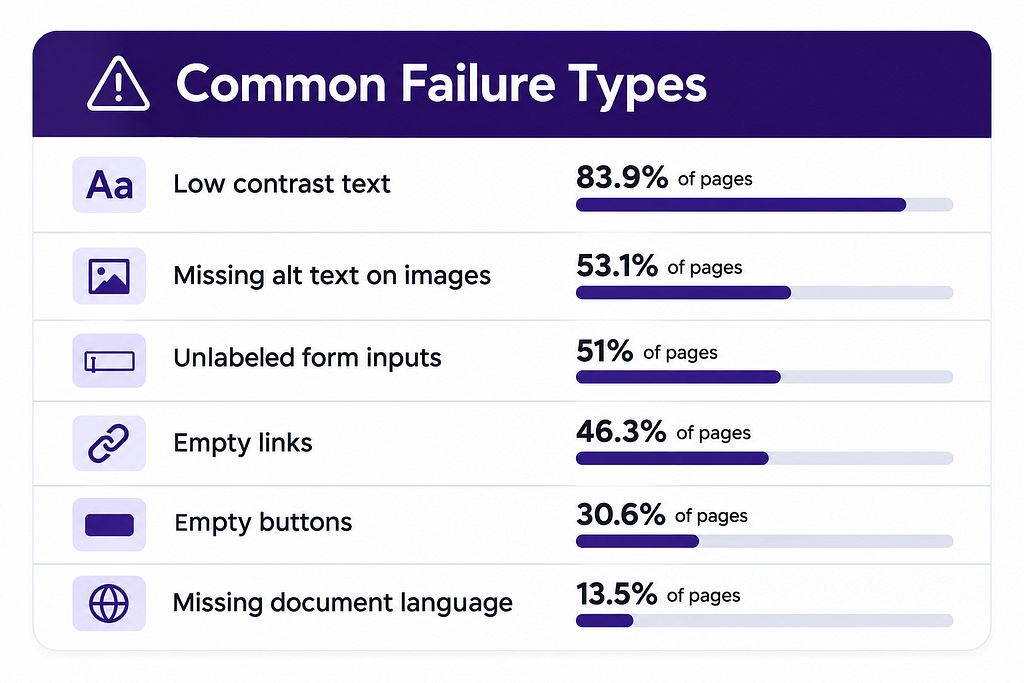
WebAIM's analysis of the top one million websites for 2026 has revealed that 95.9% of sites contain accessibility errors, with an average of 56 errors per page. The list of the most common errors—which has remained unchanged for the past seven years—shows that accessibility standards are not actually a separate area of expertise, but rather the very foundation of core visual design principles such as contrast and labeling.
The Intersection of Accessibility and Core Design Principles
The fact that the most common types of errors on the web have remained unchanged for the last seven years indicates that the issue stems from a conceptual mismatch rather than a lack of technical knowledge. Basic errors such as low contrast, missing alternative text (alt text), unlabeled form fields, and empty links are not complex rules unfamiliar to designers; they are fundamental principles learned during their early education.
For instance, the rule of visual hierarchy directly overlaps with the information relationships and heading structures outlined in WCAG standards. The failure to transfer the hierarchy established on the screen to the underlying code structure—such as skipping page levels or using multiple h1 tags—highlights the disconnect between design and technical implementation. Similarly, text legibility (contrast) ratios, the clarity of form labels, and the inclusion of meaningful content in interactive elements are integral parts of good design.
Industry Implications and the Transformation of Design Processes
Instead of viewing accessibility criteria as an external checklist, designers need to treat them as a technical and legal translation of their visual practices. The upward trend in WebAIM data proves that these core elements continue to be overlooked in design processes and that standards are perceived as a chore. This underscores the need for design teams to prioritize structural integrity from the very beginning of digital product development processes.
Frequently Asked Questions
At what stage do designers struggle the most when integrating accessibility standards into their workflows?
The difficulty usually stems not from memorizing technical standards (WCAG), but from consistently mapping core design decisions—such as visual hierarchy and contrast—to the underlying code structure (DOM).
According to WebAIM data, what is the primary reason for the increase in accessibility errors in recent years?
The fact that errors have remained identical for seven years and the number of barriers per page is increasing stems from accessibility still being viewed as an external burden added as an afterthought, rather than an integral part of the mainstream design process.
*This news article was prepared based on data published by UX Collective.
💬 Comments
No comments yet. Be the first!
You must be logged in to comment.
🔑 Log In